
Most advice about feedback is about tone – be kind, be encouraging, soften the blow. So managers reach for vague language because it feels gentler. “Just tidy it up a bit.” “Be more confident.” “Work on your communication.”
It sounds considerate. It even feels considerate. But for a lot of neurodivergent employees, vagueness isn’t the gentle option – it’s the heavy one. A specific note has edges; you know where it starts and where it stops. A vague note has no edges, so it expands to fill everything. And a brain wired to over-detect threat, or one that struggles to sit in the unknown, will fill that empty space with the worst available interpretation.
This isn’t a piece about handling delicate people carefully. It’s a piece about one small communication habit that quietly wastes your feedback, your time, and sometimes your best people – and the five-minute change that makes all of it land.
Vague feedback isn’t kinder, it’s heavier
Ambiguity is not neutral. When a review leaves a gap, someone has to fill it and, for many neurodivergent people in particular, sitting in that gap isn’t mildly annoying. It’s genuinely distressing.
“Be more proactive” is homework with no brief. The person can’t tell whether they’re failing, succeeding, or one comment away from a warning. So they run every scenario on a loop.
There’s good evidence behind this. Many neurodivergent people find uncertainty especially stressful. When something is unclear or open to interpretation, it can feel uncomfortable or even worrying, and it’s common to assume the worst when there isn’t enough information.
Researchers have been studying this for years. A 2014 study by Boulter and colleagues looked at how uncertainty links to anxiety in autistic young people, and a 2020 review in the journal Autism (by Jenkinson, Milne and Thompson) brought together multiple studies and found the same pattern again and again.
In everyday terms, it means this: a vague instruction doesn’t feel like freedom. It feels like not knowing what’s coming next, and that uncertainty can be stressful.
“Constructive” criticism can read as a verdict, not a note
Here’s the gap that catches well-meaning managers out. You think you’ve flagged one small thing. The person hears a judgment on their whole competence. And the vaguer the wording, the wider the verdict.
For many people with ADHD, criticism – even mild, even kindly meant – can set off a response far bigger than the note itself. Clinicians often describe this as rejection-sensitive dysphoria, a term associated with the work of Dr William Dodson. Vague or unexpected feedback is a particularly sharp trigger, precisely because there’s nothing concrete to fix – only the feeling of having fallen short, with no edges to grip. What follows is rumination that can run for hours or days, and a quiet flinch away from the next conversation.
This is a two-way mismatch, not an employee defect
It would be easy to read all of this as “handle the fragile person carefully.” That’s the wrong read, and it’s worth saying plainly: the employee is not oversensitive, and the manager is not careless. Vague feedback fails because two communication styles don’t match – and the mismatch runs in both directions.
The autistic researcher Damian Milton named this the double empathy problem back in 2012: when communication breaks down between autistic and non-autistic people, it’s mutual, not a one-sided deficit. Both people are working from slightly different defaults about what’s obvious, what’s implied, and what “be more proactive” could possibly mean. Naming the mismatch – rather than locating the fault in one person – is also why guidance shaped by people who have sat in that chair tends to be more useful than guidance written from the outside looking in.
Vague praise destabilises, too
This is the part most feedback advice misses. “Great work, keep it up” sounds harmless – a freebie, a pat on the back. But to a high-masking employee with no map of what specifically worked, it’s another puzzle with the answer key withheld. Which part was the great work? Better repeat all of it, just in case. So they over-do everything, every time, to stay safe.
That’s not motivation. That’s load. And it connects to something we’ve written about before: people are often praised most in the stretch when they’re closest to collapse, because masking makes overload invisible from the outside. Vague praise can quietly speed that up – it rewards the masking without ever telling the person which part actually landed.
The part that costs the business
Pull the lens back to the organisation and the picture gets expensive. Vague feedback doesn’t just sting an individual – it wastes the feedback entirely, and produces costs that never get traced back to the cause:
feedback that changes no behaviour, because no behaviour was named
hours of quiet decoding labour – pulling a colleague aside to ask “what do you reckon they actually meant?”
over-correction in three random directions at once
withdrawal from the next one-on-one, the next stretch project, the next bit of visibility
and, eventually, a quiet exit.
Neurodivergent employees disproportionately disengage and leave without ever naming why. The headline workforce figures vary by study, but the pattern in the published research is consistent: roughly one in five employees is neurodivergent, burnout can run around three times higher, and much of the resulting attrition is quiet – it never shows up labelled as what it actually was.
What actually helps
Here’s the reframe that makes the fix easy to adopt: specificity is the accommodation. It costs nothing. It requires no disclosure, no HR conversation, no diagnosis on file. It helps every employee you have, neurodivergent or not. And it’s the most respectful version of feedback, not the soft one – because you’re refusing to make someone guess.
GOOD FEEDBACK DOES FIVE THINGS
Names the behaviour, not the trait.
“You spoke over two people in Tuesday’s stand-up,” not “be more aware of others.”
Separates what happened from what it meant.
Observation first; interpretation second, and labelled clearly as your interpretation.
Shows one example of “good.”
Don’t just name the gap – point at one moment that hit the target.
States the stakes plainly.
If it’s minor, say it’s minor. An unspoken stake gets filled in as catastrophic.
Puts it in writing.
A two-line written follow-up dissolves the “wait, what did they actually say?” loop entirely.
None of this is a special carve-out. It’s the same principle behind the Situation–Behaviour–Impact (SBI) model from the Center for Creative Leadership – describe the situation, describe the observable behaviour, describe the impact, and keep your hands off the person’s character. Good feedback for a neurodivergent brain turns out to be good feedback, full stop.
But what does that look like in practice?
Theory is easy to nod along to and hard to use at 4:45 pm before a one-on-one. So here’s copy-ready language. Same note, made specific.
| Instead of: | Try: |
|---|---|
| “Be more proactive.” | “In stand-up, I’d like you to flag blockers before I ask. Last Thursday you raised the API issue after the meeting – that’s exactly the kind of thing I’d love surfaced in the room.” |
| “Work on your communication.” | “Your written updates are great. In live meetings I sometimes can’t tell when you’ve finished a point – could we agree a quick signal so I don’t talk over you?” |
| “Great work, keep it up.” | “The way you structured the client doc – headings, summary up top – made it easy to scan. Do that again on the next one.” |
If it doesn’t land: even specific feedback can sting in the moment, and that’s okay. Say so, and follow up in writing afterwards – it gives the person something solid to return to once the first reaction settles.
MICRO-SIGNS A REVIEW LANDED BADLY
output spikes, then crashes
over-apologising in the next few interactions
going quiet in one-on-ones
asking a peer “what do you think they actually meant?”
withdrawing from anything visible or optional
The goal was never softer feedback. It was clearer feedback. Vagueness isn’t a kindness you do for someone – it’s a cost you hand to them, and a brain that’s already working overtime is the one left paying it. Specificity is you doing the work of being understood, instead of leaving someone else to do it for you at the weekend.
Neuro nuggets
Practical neurodiversity support your managers will actually use.
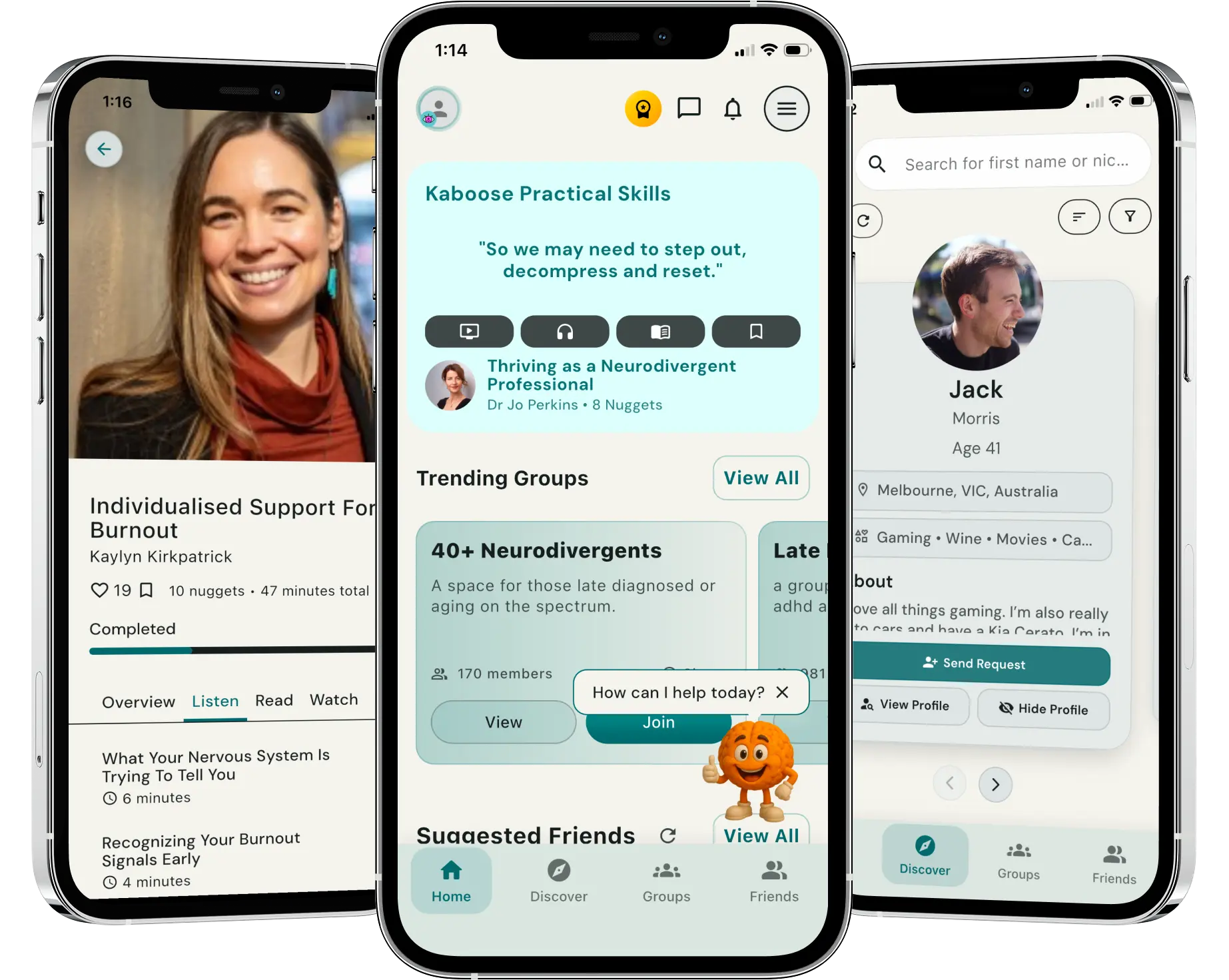
Neuro Nuggets by Kaboose builds short, manager-facing content on exactly this – how to deliver feedback that lands. It’s made by neurodivergent people and shaped by lived experience, which is the whole point: the people who’ve spent a weekend decoding “be more proactive” know precisely where the fix needs to go.