
In September 2026 we put a question to the Identity group inside the Kaboose app. It had nothing to do with work.
Do you ever struggle to tell which parts of you are masking and which are ‘really you’?
What this poll is, and what it isn’t
This was a single-question poll run in the Kaboose app in September 2026, answered by people who chose to answer it. It is not a representative survey, it did not ask about work specifically, and we did not collect diagnosis, employment status or country alongside it. Treat it as a prompt worth investigating, not as a measurement. The peer-reviewed findings cited further down are doing the analytical work in this article. The themes we describe from the discussion thread are paraphrased in summary; no individual member is quoted, identified or characterised.
The discussion underneath gave that number some texture. Members described monitoring themselves as they spoke, changing depending on who they were with, staying on guard, compensating, holding parts of themselves back, and continually weighing up whether it was safe to let those parts show. Recognisable behaviour, most of it. What stood out was how routine it sounded.
Read that result as an individual and it raises a question about identity. Read it as an employer and it raises a different one.
If adapting yourself becomes practised enough that you can no longer reliably tell where the adaptation ends and you begin, then the effort involved has stopped being visible. Including to the person spending it. And effort nobody can see is effort nobody is accounting for.
Which brings us to the question this article is actually about. How much employee energy is going into looking right, rather than working well?
The work you see, and the work you don't
It helps to separate two workloads that arrive in the same person on the same day.
Visible workload
- Writing the report.
- Managing the client.
- Analysing the data.
- Leading the meeting.
- Shipping the thing.
INVisible workload
- Monitoring your facial expression.
- Calculating when it is safe to speak.
- Suppressing movement.
- Rewriting an email four times so the tone can’t be misread.
- Tolerating sensory discomfort you have decided not to mention.
- Decoding a brief that was never made explicit.
- Producing enthusiasm on cue.
- Trying not to seem different.
Only one of those two lists was hired, scoped and paid for. Both draw down the same finite attention, from the same person, across the same eight hours.
Masking is information about the environment
The strongest workplace evidence here comes from a 2023 study out of UCL’s Centre for Research in Autism and Education, published in PLOS ONE. It compared the workplace masking experiences of autistic, non-autistic neurodivergent and neurotypical adults in the UK, with a final analysed sample of 411 people.
The researchers identified eight themes. One of them was, straightforwardly, better employment outcomes. Participants described masking in order to get hired and stay hired, to meet what they understood as professional standards, to be perceived as competent, and to progress.
All participant experiences described below are paraphrased from the two published studies cited at the foot of this page. Nothing in this article is quoted directly, from the studies or from the Kaboose community.
Participants described masking specifically to protect the position they already held. Several linked it directly to disclosure: their expectation was that naming a diagnosis would narrow the opportunities offered to them and slow their progression, so they did not name it.
The authors’ own summary is that workplace masking was an adaptive response to socially grounded workplace challenges, used to safeguard against the threat of negative social and employment outcomes.
That word adaptive is doing a lot of work, and it is the most useful thing in the paper for anyone designing a workplace. People were not masking because of a deficiency. They were masking because they had made a reasonable forecast about what would happen if they didn’t.
One answer reads as an employee trait. The other reads as feedback on the environment, which is the only one of the two you can actually do something about.
The finding everyone quotes, and the caveat nobody does
This study is frequently cited for showing that everyone masks at work, neurotypical people included. That is genuinely what the participants described, and it is a useful corrective to the idea that masking is an exotic phenomenon.
But be careful with it. Of the neurotypical people who reached the masking questions, 65.1% were excluded because they did not answer them, and more than half of those said the questions simply weren’t relevant to them. So the honest version is narrower: among neurotypical people for whom workplace masking is a live experience, the motivations look broadly similar. The authors are explicit that their autistic and non-autistic neurodivergent participants reported unique additional pressures, driven by limited understanding of neurodiversity at work. Those are not the same claim, and the difference matters if you are building policy on it.
When “professional” quietly becomes “neurotypical”
Let’s dispose of the strawman first. Work genuinely requires collaboration, reliability, clear communication and behaviour appropriate to the context. No serious argument says an organisation should hold no behavioural expectations at all.
The more interesting question is narrower, and much harder to answer honestly:
Eye contact. Visible enthusiasm in meetings. Thinking aloud rather than processing first and answering second. Networking comfortably. Producing good work in a noisy open-plan office. Attending the social. Responding within minutes. Appearing calm while overloaded.
Some of those matter enormously in some roles. Small talk is not a performative extra for a salesperson, it is the job. Fast verbal response genuinely matters in an emergency department. The point is not that these expectations are illegitimate. The point is that most organisations have never sorted them into the two piles.
A practical place to start is with the language that shows up in performance reviews, hiring debriefs and promotion panels, where these conventions get encoded as if they were capabilities.
| What gets said | What to ask instead | |
|---|---|---|
| “Makes good eye contact” | ➔ | Does this affect their ability to listen, communicate or deliver? |
| “Needs to speak up more in meetings” | ➔ | Have we offered any other effective way to contribute? |
| “Needs to be more polished” | ➔ | What observable behaviour should change, and what does it cost us now? |
| “Doesn't seem engaged” | ➔ | What evidence do we have about their actual engagement, rather than its display? |
| “Needs better executive presence” | ➔ | Which specific capability are we trying to develop here? |
| “Not a culture fit” | ➔ | Which job-relevant expectation is not being met? |
None of these questions lowers a bar. Each one moves the bar from a behaviour to an outcome, which is where a defensible performance conversation belongs anyway. As a side effect, they are also far easier to defend if a decision is ever challenged.
Performance doesn't tell you what performance costs
Here is the part organisations tend to miss, and the reason they miss it is uncomfortable: masking works.
A study published in the Journal of Autism and Developmental Disorders in August 2026 looked at 131 employed autistic adults in the United States. Overall, 86% reported camouflaging often or sometimes at work. Its five qualitative themes describe camouflaging as a response to prejudice or abuse, as a way of coping, as a response to being silenced, as compulsory production of extra labour, and as forced repression of identity.
That fourth theme is the one with the clearest organisational implication. Participants described preparing scripts for routine conversations, rehearsing facial expressions, working overtime to be certain of accuracy, and spending disproportionate time composing ordinary emails.
One participant put the trade-off in performance-review terms. Their career went measurably better when they masked, and on the occasions they stopped, negative characterisations of their manner had found their way into formal review documents.
The UK participants said much the same thing from the other side of the world. Some attributed their professional success directly to their ability to mask. One described the desire to progress as having left them without a real choice in the matter. Another said that decisions about projects and promotions frequently turned on social factors rather than capability, even in organisations that explicitly claimed otherwise.
So the employee in question may be reliable, articulate, well prepared, recently promoted and apparently comfortable. And a considerable amount of effort may be going into producing exactly that impression.
This is what breaks the common assumption that neurodivergence at work only becomes relevant once someone is visibly struggling. Frequently the employees paying most are the ones whose output gives you no reason to ask.
One response in the 2026 study should make any operations leader sit up:
The participant described deliberately withholding suggested improvements to working processes, including ones they believed would be safer, because colleagues tended to receive such suggestions as a personal attack.
That is not a wellbeing cost. That is a suppressed safety improvement, withheld because raising it was socially expensive.
What it costs
You will see confident numbers attached to this topic. Masking costs industry billions, and so on. The evidence does not support claims at that precision, and using them will cost you credibility with exactly the audience you need.
What the research does report is consistent enough to act on. The UK participants described exhaustion, anxiety, worsening physical health, and disconnection from their own identity. They also described the workplace as the context where masking was hardest to escape, because it is the one you cannot leave for eight hours a day.
One autistic participant described masking as actively degrading their capability rather than merely tiring them: they missed information, spent more energy on less, and could not work in the ways they knew they were capable of.
That is the business-relevant framing, and it is sharper than a wellbeing appeal. It is not that employees feel bad. It is that a measurable share of your people’s cognitive capacity is committed to something other than thinking, creating, problem solving, listening, learning, collaborating and recovering.
A lead worth watching, not a finding to quote
In the 2026 study, the compulsory extra labour theme appeared at a within-group rate of 77% among in-person workers, 65.2% among remote workers and 36.4% among hybrid workers. That pattern is suggestive for anyone reviewing an office attendance policy.
Be honest about its status, though. The authors ran no significance testing on these comparisons because of small cell sizes, and present them as descriptive patterns rather than inferential conclusions. The same study also notes that 79% of its sample held a college degree and that it deliberately oversampled gender and racial minorities. It is a reason to ask a question internally. It is not a statistic to put on a slide.
Don't ask people to unmask. Reduce what there is to mask.
The instinctive organisational response is a campaign: bring your whole self to work. It is well meant, and it quietly transfers the entire risk back to the employee. It asks the person with the least power in the room to go first, on the basis of an assurance the organisation has not yet earned.
The alternative is duller and considerably more effective. Design the work so fewer irrelevant behaviours have to be produced in the first place.
Agendas and pre-reading circulated before the meeting, not discovered during it
Written briefs that state the actual decision, the constraints and the definition of done
More than one legitimate way to contribute to a discussion, including afterwards and in writing
Expectations made explicit rather than left to be inferred from watching everyone else
Adjustments that don’t have to be re-justified every quarter to a new manager
And one that outranks all of them:
Nobody should have to tell their manager about a diagnosis in order to receive a clear brief, an agenda in advance, or permission to contribute in writing. Every one of the practices above improves the work for the whole team. Gate them behind disclosure and you have built a system that charges people a privacy fee for basic clarity, and then wonders why uptake is low.
The honest limits of this argument
None of this is free. Written briefs take time that verbal ones don’t. Running several participation channels is more work than running one. Managers who are already stretched will experience this as additional process before they experience it as reduced friction, and some will push back on exactly that basis. Budget for it, or it will quietly not happen.
The research is also clear that masking cannot be designed away entirely. The UCL authors say plainly that it is unlikely workplace masking can be eliminated, and recommend organisations pair any cultural work with real mental health support. The 2026 authors add a caution worth repeating: the goal is not to pressure anyone into unmasking as a performance of authenticity. That is just a new expectation wearing better clothes. The goal is to increase individual agency over when and whether masking happens at all.
The takeaway
A neuroinclusive workplace is not one where everybody feels comfortable unmasking. That standard is unreachable, and aiming at it puts the work on the wrong person.
It is one where there is less that needs masking in the first place.
That reframing does something useful to the whole topic. It turns masking from something neurodivergent employees do, into a signal that your expectations, your meeting design and your review language are worth a second look. The first is an HR matter for a minority of staff. The second is an operating question about how much of your payroll is being spent on appearance.
Neuro nuggets
Practical neurodiversity support your managers will actually use.
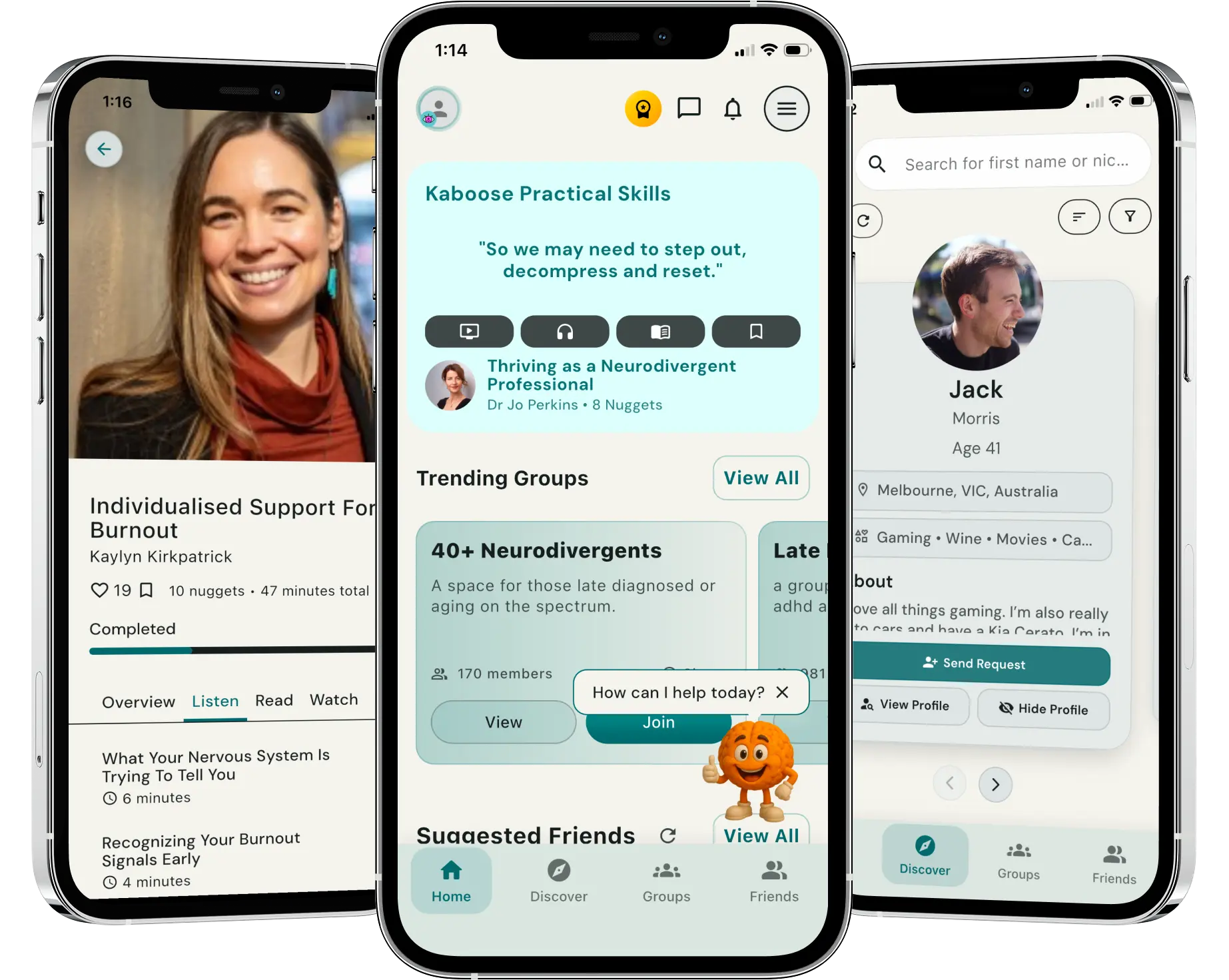
Kaboose gives employees and managers short, expert-led guidance for everyday workplace situations, shaped by lived experience. It works alongside your EAP, filling the gap between crisis support and one-off awareness training. Individual activity is never reported to employers.
Sources
Pryke-Hobbes et al. (2023), PLOS ONE. Open access study
Sherwood et al. (2026), Journal of Autism and Developmental Disorders. Open access study
Kaboose community poll, Identity group, September 2026 (n=339). Unpublished internal data.