
It's 8:57 on Monday morning
Alex opens her laptop to 42 unread messages, three ‘quick’ requests marked urgent, a meeting invitation with no agenda, and a reminder that cameras are expected to be on.
Alex is highly capable. But before she does any meaningful work, she has to decode the workplace.
Her organisation will see what she delivers by Friday. It will rarely see the energy she spent navigating the environment to get there. Researchers have a name for part of that effort. Autistic adults describe camouflaging, the work of hiding or compensating for difference, as exhausting. Over time, a mismatch between expectations and support is one of the drivers of autistic burnout.
So this is an article about neurodiversity in the workplace. It is also an article about performance, leadership and how work gets designed. The talent is present. The performance is obstructed.
What is neurodiversity in the workplace?
Neurodiversity describes the natural variation in how people think, communicate, process information and experience the world. The term comes from Australian sociologist Judy Singer, and it now covers a range of neurotypes that often overlap.
| Neurotype | In simple terms | How it can show up at work |
|---|---|---|
| ADHD | Differences in attention and executive functioning | Time-blindness, many tasks open at once, trouble prioritising |
| Autistic | Differences in communication and sensory processing | Preference for structure, clarity and routine |
| AuDHD | Co-occurring autism and ADHD | Competing needs for structure and novelty |
| Dyslexia | Differences in processing written language | May use reading and writing accessibility tools |
| Tourette syndrome | A neurological condition involving involuntary tics | Motor or vocal tics may be more noticeable under stress |
| Dyspraxia (DCD) | Differences in coordination, movement and planning | Challenges with fine-motor tasks, sequencing, navigation |
There is no single way neurodivergence looks, and a list of challenges is only half the picture. A review in the British Medical Bulletin describes a ‘spiky profile’: real difficulties sitting alongside real strengths. The strengths it reports include creative thinking and hyperfocus (ADHD), memory and attention to detail (autism), visual reasoning and entrepreneurialism (dyslexia) and strong verbal comprehension (DCD).
It is also common. A global meta-analysis in the Journal of Global Health estimates that 2.6% of adults have persistent ADHD and 6.8% have symptomatic ADHD. Autism and ADHD frequently co-occur.
Neurodivergent employees in Australia: what the numbers show
We often mistake environmental friction for individual limitation. Performance is produced by the interaction between a person, their role, their environment and their support. It is never produced by the person alone. Three numbers show what happens when that interaction fails.
About 1 in 5. An estimated 15–20% of the population is neurodivergent, according to the British Medical Bulletin review. That is an estimate built from overlapping prevalence figures, not a census count.
61%. In a DXC Technology survey of 1,410 Australians, 61% of respondents said they would not feel comfortable disclosing neurodivergence to a potential employer, for fear of harming their career.
Less than half the tenure. The same survey found neurodivergent Australians stay in a role for 4.4 years on average, against 9.1 years for neurotypical Australians.
The survey is industry-commissioned, but peer-reviewed research points the same way. A study of more than 25,000 people in Human Resource Management found neurodivergent workers were twice as likely to be in precarious employment and had lower job tenure. Wages were no different once other factors were controlled for.
National data is starker still. The Australian Bureau of Statistics puts unemployment for working-age Autistic people at 18.2%, almost six times the rate for people without disability (3.1%).
The performance equation has four parts
At Kaboose we use a simple working model: Capability × Clarity × Environment × Trust = Performance. It multiplies, so a near-zero in any one part drags the whole result down, however strong the other three are.
| Part | The question to ask |
|---|---|
| Capability | Does the role use the person's strengths? |
| Clarity | Are expectations and priorities explicit? |
| Environment | Does the environment support productivity? |
| Trust | Is it safe to ask for what they need? |
Most organisations manage capability closely and leave the other three to chance. At 8:57, Alex’s capability was never in question. Clarity, environment and trust were.
Two places to start:
Surface the hidden friction. Ask employees which parts of the working day consume unnecessary energy.
Create clarity early. Make priorities, deadlines, meeting purposes and communication expectations explicit.
Neuroinclusive hiring: at 10:00, Alex enters the talent system
Exclusion can appear completely neutral. No one sets out to design an interview, an onboarding week or a promotion round that filters out capable people. It happens through habits nobody has questioned, at every stage of the employee lifecycle:
Attract → Recruit → Onboard → Develop → Perform → Progress → Retain
Take the interview. The useful question is whether we are measuring the capabilities required for the job, or familiarity with the assessment ritual.
A study in the journal Autism ran mock interviews with 25 autistic and 25 non-autistic adults. Employment experts, unaware of who was autistic, rated the autistic candidates less favourably on standard questions. When the questions were adapted to be more specific and structured, the autistic candidates’ ratings improved.
This is good selection practice in general. A major review in the Journal of Applied Psychology found structured interviews are among the strongest predictors of job performance.
Four strategies follow:
Assess the actual work. Use structured interviews or practical tasks that reflect the role.
Make selection predictable. Provide clear instructions, interview formats and questions in advance where possible.
Audit the employee lifecycle. Review hiring, onboarding, meetings, performance and promotion for barriers.
Challenge unwritten rules. Question whether ‘professional’ expectations, such as cameras always on, actually affect performance.
The business case for neuroinclusion
When workplace barriers suppress talent, the cost lands in performance, wellbeing and retention, well beyond any diversity dashboard.
The clearest Australian figure comes from ADHD. A study in the Journal of Attention Disorders estimated the national cost of ADHD for 2018–19 and found that lost productivity made up 81% of the financial costs. Health system costs were 4%.
The fix is usually cheap. UK data cited in the British Medical Bulletin puts typical workplace adjustments for neurodivergent employees at under £1,200 per person, less than the cost of re-recruiting.
The evidence has limits, and it is worth being honest about them. The same review notes that few studies have tested which adjustments work best, for whom. That is a reason to measure your own results, not a reason to wait.
Connect inclusion to performance data. Track retention, absence, engagement, productivity and adjustments, alongside representation.
Identify the cost of friction. Find where unclear or inflexible processes drive rework, burnout or talent loss.
How to support neurodivergent employees: replay Monday with better work design
Give Alex the same job, with the same standard. This is the removal of irrelevant barriers, with no reduction in accountability.
| Monday 1 | Monday 2 |
|---|---|
| Back-to-back meetings | Agenda in advance |
| Noisy office | Focus block |
| Vague brief | Clear brief |
| Constant interruptions | Async update |
None of this is exotic. Neuroinclusive design is often just better management, and the research on ordinary work backs it. An experiment on interrupted work found that people compensate for interruptions by working faster, at the price of more stress and frustration. The Human Resource Management study above found flexible and home working raised job tenure for neurodivergent employees.
How managers can support neurodivergent employees
Managers turn policy into daily experience. They do not need to diagnose anyone. They need to create clarity, listen well and act on reasonable information.
Equip managers with practical questions. ‘What helps you do your best work?’ and ‘What’s making this harder?’
Focus feedback on impact. Talk about behaviour, impact and outcomes, and leave personality and communication style out of it.
Make clarity the default. Written priorities, structured meetings, clear deadlines, clear measures of success.
Provide choice where possible. Offer different ways to receive information, contribute ideas and complete work.
Consistency does not mean giving everyone identical conditions. It means applying fair principles reliably.
From accommodations to organisational capability
Remember the 61%. If support depends on disclosure, most of the people who need it will never ask. Psychological safety, the shared belief that it is safe to speak up, is what the Trust part of the equation measures.
Universal design should reduce the number of people who must disclose simply to access workable conditions. Build accessibility and flexibility into standard practice, and make neuroinclusion a shared responsibility across teams.
Individual adjustments still matter. In Australia, employers must make reasonable adjustments under the Disability Discrimination Act 1992, and JobAccess can help fund them. Inclusive defaults simply mean fewer people have to fight for the basics.
Alex's talent was never the variable
On the first Monday, Alex finished the day exhausted from navigating the workplace. On the second, she spent that energy solving problems, contributing ideas and delivering meaningful work.
Alex did not become more capable between those two Mondays. The workplace became more intelligent.
Lorem ipsum dolor sit amet, consectetur adipiscing elit. Ut elit tellus, luctus nec ullamcorper mattis, pulvinar dapibus leo.
Neurodiversity training that sticks: where Kaboose fits
A one-off training session reaches a cohort, on a date set weeks in advance. Alex’s manager needs help at 8:57 on a Monday.
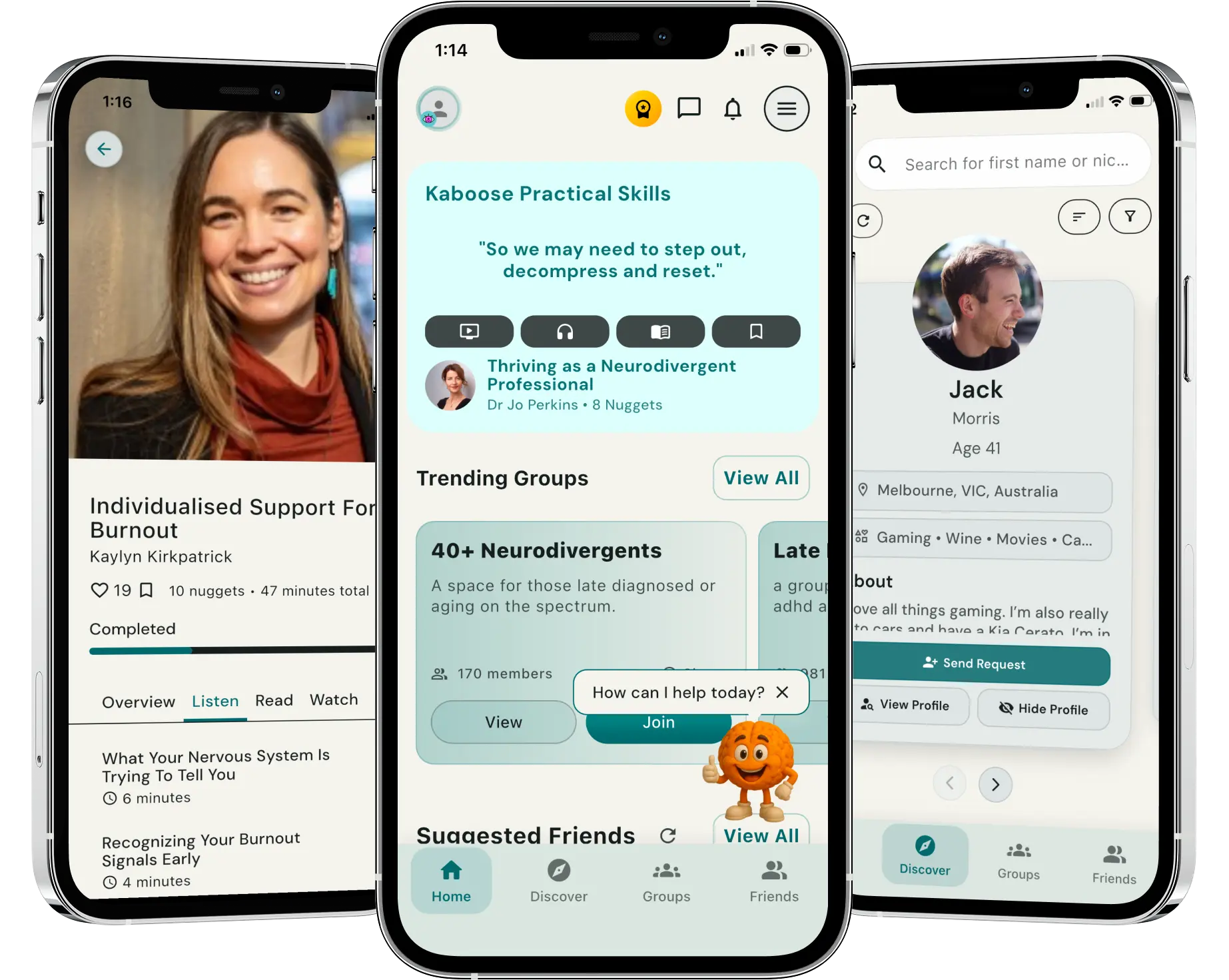
Kaboose gives organisations always-on neuroinclusion support their people can use every day:
Neuro Nuggets: More than 400 pieces of practical micro-learning, with new ones added monthly. They are made by neurodivergent professionals and lived-experience experts, and answer questions such as ‘How can I support a team member who’s overwhelmed?’ and ‘How do I tell my manager I have ADHD?’
Community: Belonging and peer support, included with the platform.
Events: Live learning and connection that reinforces the education, also included.
Belonging drives engagement, and engagement is why the learning lands.
Neuro nuggets
Practical neurodiversity support your managers will actually use.
Kaboose gives employees and managers short, expert-led guidance for everyday workplace situations, shaped by lived experience. It works alongside your EAP, filling the gap between crisis support and one-off awareness training. Individual activity is never reported to employers.
What is neurodiversity in the workplace?
Neurodiversity in the workplace is the natural variation in how employees think, communicate and process information. It includes neurotypes such as ADHD, autism, dyslexia, dyspraxia and Tourette syndrome.
How many employees are neurodivergent?
An estimated 15–20% of people are neurodivergent, or about 1 in 5. Many have not told their employer.
What is neuroinclusion?
Neuroinclusion means designing work so people with different neurotypes can perform at their best. In practice it means clear priorities, structured meetings, flexible ways of working and managers who ask what helps.
Why don't neurodivergent employees disclose at work?
Mostly fear of career harm. In one Australian survey, 61% said they would not feel comfortable disclosing to a potential employer.
What are reasonable adjustments for neurodivergent employees?
Common examples are flexible hours, quiet spaces or noise-cancelling headphones, written instructions, agendas in advance and assistive technology such as text-to-speech.