
Masking is information about the environment.
Australia’s psychosocial hazard laws ask employers to manage the way work is designed, not just how people cope with it. For neurodivergent employees, many of the listed hazards (unclear roles, poor support, badly managed change, a hostile physical environment) hit harder and earlier. If your risk assessment treats your workforce as one average worker, it is probably missing the people most exposed.
This article explains what the law requires, where neurodiversity fits, and what a practical, defensible response looks like. It is general information, not legal advice.
What are psychosocial hazards?
Psychosocial hazards are aspects of work, and situations at work, that can cause a stress response which may lead to psychological or physical harm. Safe Work Australia’s model Code of Practice: Managing psychosocial hazards at work sets out common examples, and state codes follow it closely. The NSW code, for instance, lists:
role overload and role underload
role conflict or lack of role clarity
low job control
poor support from supervisors, managers and co-workers
poor organisational change consultation
poor procedural justice
inadequate reward and recognition
conflict or poor workplace relationships, bullying and harassment
hazardous physical working environments
remote or isolated work, traumatic events and workplace violence
None of those hazards mention neurodiversity by name. That is exactly why so many organisations miss the connection.
What does the law require?
Under the model Work Health and Safety Regulations (adopted in most states and territories), a person conducting a business or undertaking (PCBU) must manage psychosocial risks the same way it manages physical ones: identify hazards, eliminate the risk so far as is reasonably practicable, minimise what cannot be eliminated, and review controls. Workers must be consulted along the way.
Victoria now has its own version. The Occupational Health and Safety Amendment (Psychological Health) Regulations took effect on 1 December 2025, with no transition period. As Norton Rose Fulbright summarises, they require employers to reduce risk first by changing how work is managed, designed and organised. Information, instruction and training can only be the main control when those changes are not reasonably practicable.
Read that last point twice. A one-off awareness session cannot be your primary control for a psychosocial risk in Victoria, and regulators elsewhere have taken a similar line in their guidance. Training supports a control. It is rarely the control.
Where neurodiversity fits into psychosocial risk.
An estimated 15 to 20% of people are neurodivergent, a figure cited by Diversity Council Australia. Many of them have not told their employer. In a DXC Technology survey of Australians reported in our neurodiversity in the workplace guide, 61% said they would not feel comfortable disclosing to a potential employer.
So the people most affected by certain hazards are often invisible in your data. Here is how common hazards can land differently.
| Psychosocial hazard | How it can show up for neurodivergent workers | Design-level control |
|---|---|---|
| Lack of role clarity | Unwritten expectations have to be decoded, which costs energy and invites mistakes | Written priorities, definitions of done and decision owners |
| Poor change consultation | Sudden changes to tools, rosters or teams disrupt routines that hold work together | Advance notice, a written change plan and a named contact |
| Poor support | Managers unsure how to respond to an adjustment request, so nothing happens | Manager guidance at the moment of need, plus a simple adjustment process |
| Hazardous physical environment | Noise, lighting and open-plan interruption cause sensory overload | Quiet zones, headphone norms, booking-free focus spaces |
| Poor procedural justice | Performance judged on style (eye contact, speaking up) rather than outcomes | Observable, job-relevant criteria in reviews and promotions |
| Role overload | Executive function load from constant task-switching and interruptions | Protected focus time, fewer concurrent priorities |
| Conflict or poor relationships | Direct communication misread as rudeness, or social cues missed | Team communication agreements that name preferences openly |
There is a second layer. Many neurodivergent employees manage these hazards by masking: suppressing natural behaviour to appear typical. Our article on masking at work covers the research. Masking keeps performance looking fine while the cost builds, which means the hazard does not show up in your incident data until someone burns out. Our piece on neurodivergent burnout explains why rest alone does not fix it.
Why this is a compliance issue, not only an inclusion one.
Mental health conditions made up 12% of serious workers’ compensation claims in 2023–24, up 14.7% on the year before, according to Safe Work Australia’s Key Work Health and Safety Statistics 2025. Median time lost for these claims is close to five times that of other serious claims.
Two legal duties also overlap here:
WHS duty. Manage psychosocial risks across the whole workforce, through work design first.
Discrimination law. The NSW code of practice notes that where a worker’s individual circumstances increase their risk, the employer must make reasonable adjustments under the Disability Discrimination Act 1992. We cover that duty in reasonable adjustments without a diagnosis.
A risk register that names “workload” but never asks who experiences workload differently may not hold up well if a claim or inspection tests it.
How to manage psychosocial risk with neurodiversity in mind.
1. Identify hazards with the people affected.
Consultation is a legal requirement, and it is where most neuro-blind assessments fail. Ask about the working day, not about diagnosis. Questions like “Which parts of your week cost the most energy for the least output?” surface sensory, clarity and change hazards without anyone having to disclose. Offer written and anonymous ways to answer, not just a workshop.
2. Assess risk by exposure, not by average.
When you rate a hazard, ask who is most exposed and for how long. An open-plan floor may be a mild irritant for most staff and a daily overload for some. The risk rating should reflect the people most affected.
3. Control at the source.
Prioritise changes to how work is organised:
agendas and pre-reading before meetings
written briefs that state the decision, constraints and deadline
predictable change processes with notice periods
quiet space and flexible hours available without negotiation
more than one way to contribute, including in writing and after the meeting
These are universal design controls. They reduce risk for everyone and remove the need for many individual requests.
4. Make individual adjustments easy to get.
Universal design will not cover everything. A clear, quick adjustment process, owned by the manager and backed by HR, is itself a control for the “poor support” hazard. Do not require a diagnosis to start the conversation.
5. Equip managers for the moment, not the module.
Most psychosocial risk is created or reduced in ordinary moments: the feedback conversation, the missed deadline, the request for flexibility. Managers need practical guidance they can reach when that moment happens. A yearly workshop cannot be in the room at 9am on a Tuesday.
6. Monitor and review.
Track team-level signals: unplanned leave, turnover, adjustment requests and their turnaround time, and survey items on clarity and support. Review controls when something changes, such as a restructure or an office move.
Questions for your next risk review.
Bring these to the next meeting where your psychosocial risk register is reviewed:
For each hazard, which roles or people are most exposed, and how do we know?
Which controls change the work itself, and which rely on training or awareness?
How long does an adjustment request take from first conversation to decision?
What happens to adjustments when a manager changes or a team restructures?
Can people raise sensory, clarity or workload issues without disclosing a diagnosis?
When did we last ask workers, in writing and anonymously, what costs them the most energy?
If several answers are “we don’t know”, that is your action list.
Common mistakes to avoid.
Making training the whole plan. In Victoria this now sits awkwardly with the hierarchy of controls.
Waiting for disclosure. If support depends on a diagnosis, most people who need it will never ask.
Treating neurodiversity as a wellbeing add-on. It belongs in the risk register, with owners and review dates.
Collecting sensitive data without a plan. DCA’s 2026 Neurodiversity Data at Work guide stresses voluntary, private collection and a commitment to act on results.
Where Kaboose fits.
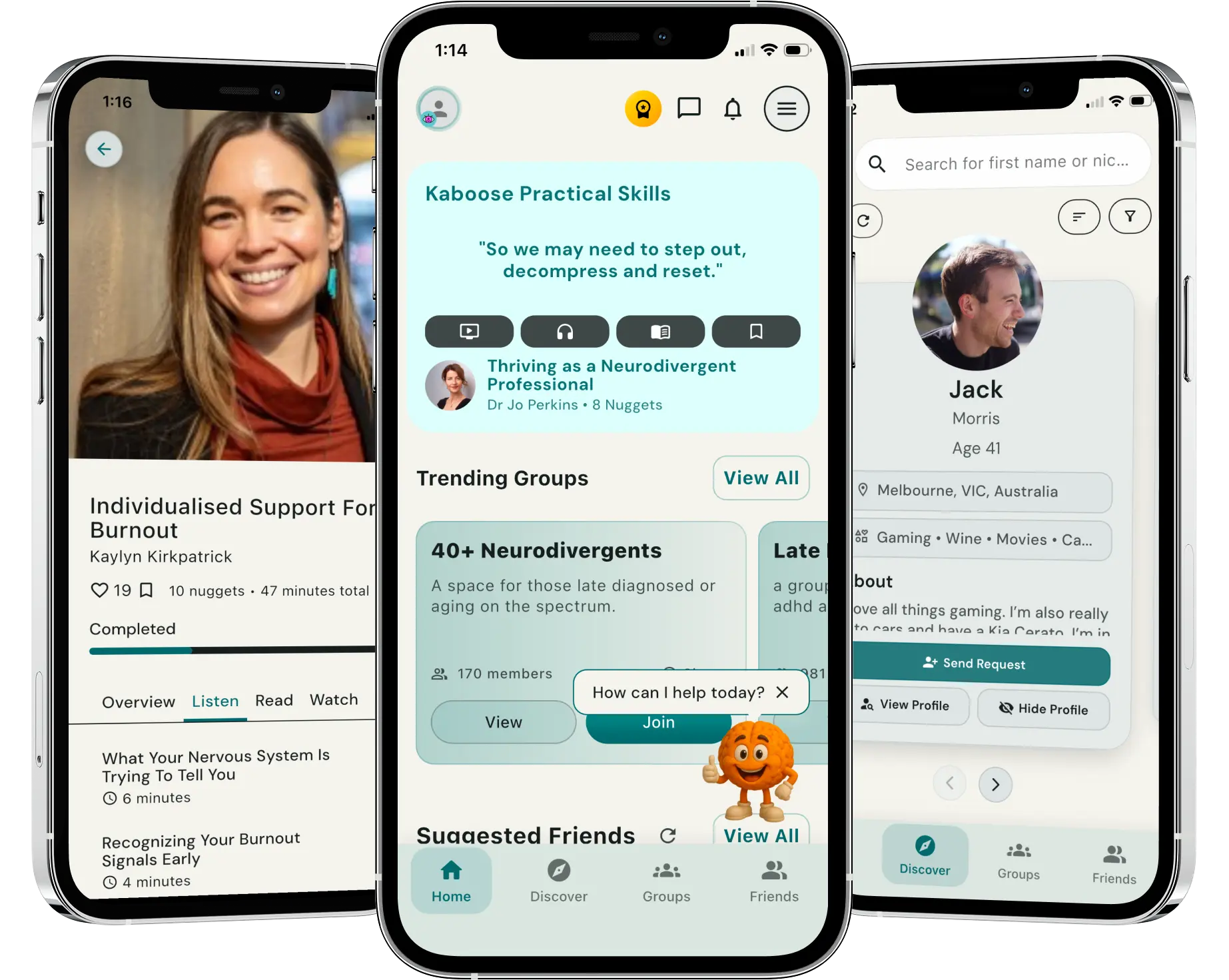
Policies don’t reduce psychosocial risk. People do. Kaboose gives managers and neurodivergent employees short, practical Neuro Nuggets for the everyday situations where risk is made or reduced, without anyone needing to disclose. Organisations see team-level adoption only, never individual activity.
See how Kaboose supports psychosocial risk management or book a 20-minute demo.
Is neurodiversity a psychosocial hazard?
No. Neurodivergence is not a hazard. The hazards are features of work, such as unclear roles, poor support or a noisy environment, that can affect neurodivergent workers more severely. The employer’s job is to manage those features.
Do employers have to know who is neurodivergent to manage psychosocial risk?
No. Most effective controls are universal: clear briefs, predictable change and flexible ways of working. Individual adjustments still matter, but they should not depend on a diagnosis.
Is neurodiversity training enough to meet psychosocial obligations?
Usually not on its own. Regulators expect changes to work design first. Training and guidance support those changes, and Victoria’s regulations limit training to a supporting role where design changes are reasonably practicable.
When did Victoria's psychological health regulations start?
They commenced on 1 December 2025 and apply to all Victorian employers, with WorkSafe Victoria’s Compliance Code providing practical guidance.
What is the first step for an employer?
Review your psychosocial risk assessment and ask, for each hazard, who is most exposed. Then consult those workers in ways that do not require disclosure.